Casino odds, explained: what the house edge takes
Casino odds are built on a fixed house edge baked into every payout table, quietly shaping why games feel generous yet still profit the house
5 min read
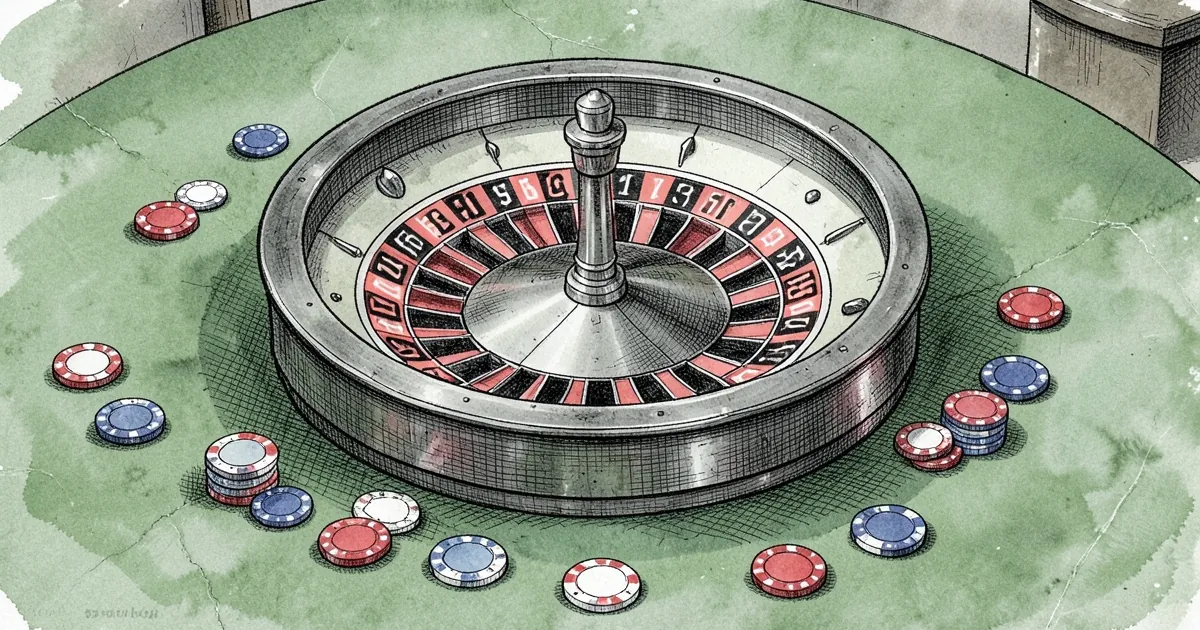
Casino odds work by pricing every bet so the operator keeps a small, fixed slice of everything staked over time — the house edge. That slice is built into the rules and the payout table, not into your luck, and it's the reason a game can feel generous on any given night while still grinding out a profit for the house across millions of rounds. The number you should care about isn't whether you won last session; it's how much of each bet the game quietly keeps.
The edge is subtraction, not magic
Start with the payout. Roulette is the cleanest teaching tool because the maths sits in the open. A European wheel has 37 pockets, 1 through 36 plus a single zero. Bet a single number and a win pays 35 to 1. But there are 37 equally likely outcomes, so the true odds against you hitting are 36 to 1. You're paid as if there were 36 pockets when there are 37. That one extra pocket is the edge: 1/37, or about 2.7%.
American roulette adds a double zero, making 38 pockets, and the payout stays at 35 to 1. Now the gap is 2/38, roughly 5.26%. Same spin, same felt, nearly double the tax. Nothing about the ball changed — only the number of spaces it can land in.
That's the whole concept. The house edge is the distance between what a fair payout would be and what the game actually pays, expressed as a percentage of your stake. Every casino game is a variation on this subtraction. Slots do it by weighting reel strips and setting paytables; blackjack does it through dealer rules and the option to double or split; sportsbooks do it by shading the two sides of a market so the implied probabilities add up to more than 100%.
The two numbers that matter
House edge is what the operator expects to keep per bet. RTP (return to player) is its mirror: 100% minus the edge. A slot with 96% RTP has a 4% edge in theory. A 2.7% roulette edge is a 97.3% RTP.
The catch is where each number lives. The edge is derivable from the rules — you can calculate it yourself. The RTP is a design figure that may be measured over tens of millions of spins, and it's often printed on a banner rather than buried in the paytable. That gap between the marketing number and the operational one is worth understanding: the house edge is on the rules page; the RTP badge is on the banner, and they don't always describe the same thing.
What the edge actually takes, in money
Percentages hide the scale. Convert them to cash and the picture sharpens.
Take a player staking $1,000 a week on a 96% RTP slot. The expected loss per week is $40. Over a year, about $2,080 — more than double the weekly stake, because you're paying the edge on every spin, not on your starting balance. On European roulette at 2.7%, the same $1,000 of action costs an expected $27. On the American wheel, $52.60.
A concrete anchor: at 96% RTP, running $10,000 through a slot carries an expected cost of $400. That figure assumes perfect randomness and enough volume for the average to bite. In a short session, variance swamps it — you might be up $600 or down $900 after 500 spins. The edge doesn't promise you'll lose tonight. It promises the operator will collect across everyone who plays.
This is also why "high RTP" claims deserve scrutiny. A 0.5% difference in RTP — say 96.5% versus 96% — sounds trivial. On $10,000 of annual action it's $50 a year. On $100,000 it's $500. Small edges compound because you pay them repeatedly, not once.
Why a bigger edge can feel smaller
Here's the counterintuitive part: the percentage isn't how players experience cost. Structure and friction matter as much as the number.
A 5% edge charged openly on a simple, transparent bet can feel fairer than a 2% edge buried behind a withdrawal fee, a currency conversion spread, or a bonus whose wagering requirement quietly multiplies the amount you must churn. That's the argument in a 5% house edge feels fairer than a 2% one with a fee — the headline percentage is only one line item in the real cost of playing.
Friction shows up in places that never appear on a paytable. A slow backend that delays your cash-out, a payment processor that treats a win like a refund to be investigated, a terms document that takes nine times longer to load than the odds feed — none of these are house edges in the mathematical sense, yet each costs you money or time. Backend delays cost more than any house edge ever will makes the case plainly: a 3% edge you understand is cheaper than a 1% edge attached to a two-day payout queue.
Speed as a hidden variable
Crash-style games illustrate it well. The edge is baked into the multiplier curve, but the real skill is reading when to cash out — and the interface's refresh rate changes your outcome. Crash games: three taps to cash out, nine to read the curve is about exactly this: the maths is fixed, the execution isn't, and a laggy tap costs more than a fraction of a percent.
Comparing games without fooling yourself
If you want to compare odds honestly, line up three things: the theoretical edge, the variance, and the terms attached to any bonus.
| Game | Typical edge | Notes |
|---|---|---|
| Blackjack (basic strategy) | ~0.5% | Depends heavily on rules; poor play pushes it past 2% |
| European roulette | 2.7% | Fixed, knowable, same on every bet type |
| American roulette | 5.26% | The double zero is the whole difference |
| Slots | 2–10%+ | RTP varies by title and by operator settings |
| Sportsbook | ~4–5% | Shaded into the odds; shop lines to reduce it |
Variance is the other half. A low-edge game with high variance (some blackjack side bets, most jackpots) can wipe a bankroll faster than a higher-edge game with low variance. Edge tells you the direction of travel; variance tells you how bumpy the road is. Neither tells you what happens in your next 100 bets.
Bonuses complicate the arithmetic further. A deposit match with a 35x wagering requirement on a 96% RTP slot effectively raises the edge on that money until the requirement is cleared. The headline "bonus" is a marketing figure; the real cost is the churn. Run the numbers before you accept, and check whether the terms load faster than the withdrawal button.
Where the edge stops being the story
The maths is settled — the edge is real, calculable, and unavoidable over volume. What's less settled is whether players are given the information to act on it. Regulators in several markets now require RTP disclosure, but the format varies: a single figure on a splash screen, a range across a game family, or a number that changes with operator configuration. Two players on the same slot in different jurisdictions can face different edges on identical graphics.
So the open question isn't "what is the house edge" — you can calculate that in a minute. It's whether the number you're shown is the number you're playing, and who's accountable when they diverge. If you can't find the edge on the rules page, treat the game as unpriced, and set your limits accordingly.